

If you've been researching workplace safety obligations in B.C., you've probably come across 2 terms that sound similar but are often mistakenly considered interchangeable: the Joint Health and Safety Committee (JHSC) and the Worker Health and Safety Representative (WHSR).
But they're not quite the same.
So, which one applies to your workplace?
Starts with 👉 the headcount. This determines the base requirement.
- 20 workers and counting → You need Joint Health and Safety Committee (JHSC).
- 10 to 19 workers → You need a Worker Health and Safety Representative (WHSR) instead.
- 9 or fewer workers → Neither is formally required under this specific rule, but doesn’t mean you’re fully exempted. Learn more here.
What's Actually Different Between Them?
Structure
A JHSC is a group — a minimum of four members, split between representatives from worker and employer, with two co-chairs. A worker health and safety representative, on the other hand, is a single individual selected from the workforce at the very minimum.
Duties and Functions
A Joint Health & Safety Committee (JHSC) brings together worker and employer representatives, alongside co-chairs, to work collectively on workplace health and safety. The committee provides a formal forum to identify hazards, address concerns, make recommendations, and help improve the workplace’s overall health and safety program.
A Worker Health & Safety Representative, on the other hand, serves as the designated worker representative in a smaller workplace, representing the workers to voice out health and safety issues and helping address their concerns.
Here's the part that surprises people: where practicable, a worker health and safety representative carries out the same duties and functions as a JHSC. That includes identifying hazards, consulting with the employer, participating in inspections, and being involved in incident investigations. The core job is nearly identical — it's just performed by one person instead of a committee.
Formality of Process
A JHSC operates with more formal governance: rules of procedure, co-chairs, meeting minutes, quorum requirements, and a structured recommendation process. A worker health and safety representative role is inherently less formal simply because there's no group to coordinate — but the underlying legal responsibilities don't disappear.
Training Requirements
Both roles benefit from structured training, and much of the content overlaps. Both training need to cover topics such as understanding duties under the Act, participating in inspections, handling incident investigations, and knowing the work refusal process.
If you're a representative rather than a committee member, you're still expected to know this material even though you're carrying out the role on your own, without co-chairs or fellow committee members to lean on.
The difference is in the training duration. WorkSafeBC specifies 4 hours of training for Worker Health & Safety Representatives and 8 hours for JHSC members.
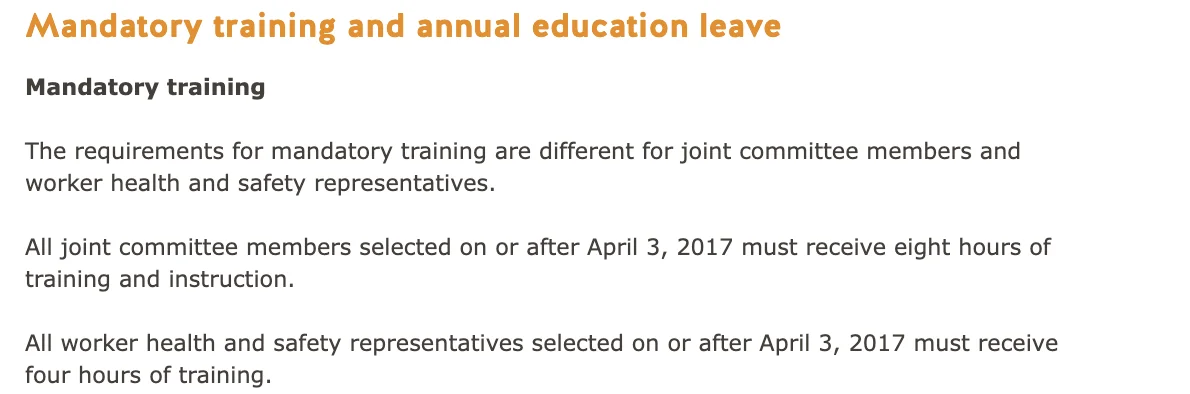
Source: Screenshot from WorkSafeBC website, "Joint health & safety committees and worker health & safety representatives."
What If Your Workforce Grows (or Shrinks)?
This is where a lot of workplaces get caught off guard.
What if you normally have 19 workers, but you take on a new project and hire one additional part-time worker to help?
Does the fact that the project is temporary mean you don't need a JHSC? Not necessarily.
For example:
Today → You have 19 existing workers.
Next week → You hire one new worker, full- or part-time, bringing your workforce to 20.
After one month → If that worker remains employed, you now have 20 workers who meet WorkSafeBC’s criterion for being regularly employed and they can count toward the 20-worker threshold. Therefore, JHSC requirement applies.
The key point? A worker doesn't automatically stop counting because they're part-time or were hired for a specific project.
WorkSafeBC considers workers who have been employed at the workplace for at least one month as “regularly employed”, regardless of how their employment status is defined. Conversely, workplaces that scale down don't automatically get to dissolve a committee without proper process.
So, 20 isn't just a headcount to keep an eye on. It can change how your workplace must structure worker health and safety representation.
The practical takeaway
Review your worker count regularly. Especially if you're a growing business, or if your workforce changes with new projects, seasonal work, or contracts.
Keep track of your workers and upcoming hires. If you're at 19 workers and planning to bring someone on, consider whether that person will remain employed at the workplace for at least one month. Keeping a simple record of who is employed at the workplace and when they started can make it easier to determine when the one-month criterion is met.
Don't overlook temporary, seasonal, hybrid, or part-time workers. If you're close to the 20-worker mark, remember that a worker's part-time or project-based status doesn't automatically mean they don't count.
Revisit your requirements when your workforce changes. Hiring, reducing staff, or taking on a new project can all be good reasons to review whether your current health and safety representation meets the requirements.