

One of the most common questions we hear is simple: "Do we actually need one of these?"
Then, there’s the follow-up: “But we only have 20 employees, so we don’t need one”
Yes, the answer does depend on your headcount, but the details matter more than most people expect. And this is where many business owners, safety managers, or CSOs are getting it wrong.
The Basic Threshold
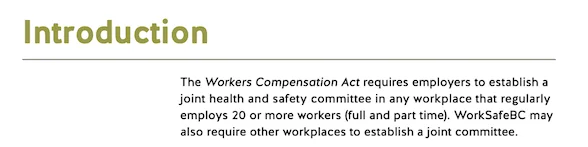
According to the Workers Compensation Act, Part 2, Division 5, Section 31, any workplace that regularly employs 20 or more workers is legally required to establish a Joint Health and Safety Committee (JHSC).
Here's where many workplaces get tripped up:
- It's "20 or more", not "more than 20." These certainly do not carry the same meaning. Many workplaces thought they only need to establish the joint committee when they hire employee #21, which is a big mistake and can be a costly one too.
- Regularly matters: A one-time spike to 22 people for a busy weekend doesn't necessarily triggers the requirement. It's about your normal, ongoing staffing level.
- Length of employment matters too. WorkSafeBC states that the requirement applies when 20 or more workers are employed at the workplace for longer than one month.
- Part-time counts. You don't get to exclude part-time or casual staff from the headcount. As outlined in the Handbook for Joint Health and Safety Committees (page 1), if your total regular workforce —full and part-time combined— hits 20, the requirement applies.
What If You're Under 20 Workers?
If your workplace regularly employs more than 9 but fewer than 20 workers, you're not off the hook. You just have a different requirement.
Instead of a full committee, you need a Worker Health and Safety Representative. Where practicable, this person carries out the same duties and functions as a JHSC would, just on a smaller scale and without the full committee structure.
If you're under 10 workers, there's no formal committee or representative requirement under this specific rule, but general occupational health and safety obligations still apply to every workplace, regardless of size.
There is one important exception: WorkSafeBC can still order a workplace to establish a committee, even if it has fewer than 20 workers. This typically depends on factors such as risk level or workplace history.
Getting It Right From Day One
Whether you're setting up your first JHSC or formalizing it, the structure and training requirements are specific — and shortcuts tend to show up later, usually during an inspection or after an incident.
Our Joint Health and Safety Committee (JHSC) training is built around WorkSafeBC requirements and regulations, so your committee is compliant, confident, and functional from the very first meeting.